
“A Different Conversation About Autism and Childhood Mental Health”
Let's support a hope-building pathway for parents that helps them discover how they can make a difference in their child's functioning and coping.

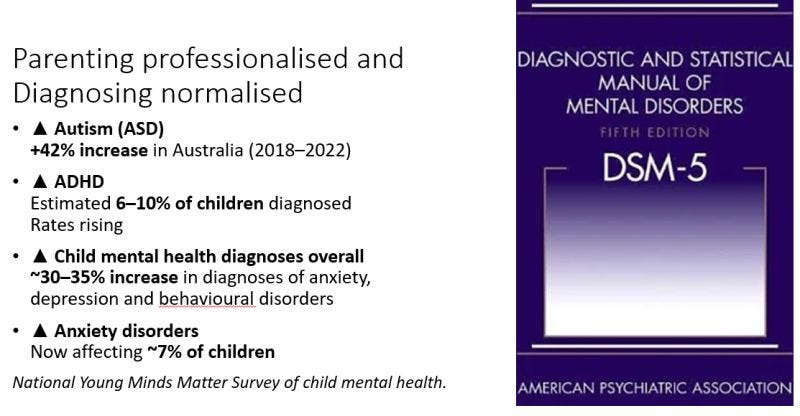
I know it's not a popular idea, but I am putting out there that the massive inflation in autism (any other) diagnoses is not helping anyone. Not children, not parents, not teachers. An anxious focus with a sickness/neurological lens is going to amplify kids' reactivity and parents' sense of helplessness. And teachers are having to navigate increasing numbers of individualised educational plans while searching for behavioural management techniques that bring limited results. I understand that a diagnostic label alleviates parental guilt and opens access to more resources —and parents need both of these things. However, there is an alternative path. Parents discovering what they can do to turn down the worry intensity and discover their "I" stance - what they can say no and yes to without power struggles and accommodations.
I'm not saying there aren't genuine cases of autism from birth, or that there may be factors not yet substantiated that have contributed to a jump in autism-like symptoms. However, the extent of this inflation points to more social, relational environmental factors -- in both families and society. (And yes - this applies to other children's mental health diagnoses.) Dr. Murray Bowen noted that a projection process can contribute to the development and maintenance of symptoms in children. There is ample research literature to support this. And a growing number of credentialled voices to raise the alarm - i.e., Allen Frances, an American psychiatrist who was Chair of the DSM-IV task force, & who writes about the medicalisation of normal behaviour; and UK psychiatrists Uta Frith and Dr Sami Timimi, who criticise overdiagnosis and the medicalisation of childhood. The neurodiversity movement started in the late 1990's, the decade where society poured massive attention to analysing our brains. Timimi writes: "No unique, characteristic, and reliable findings in genetic, neuroanatomical, neurofunctional, or neurochemical investigations have been discovered. This is why all assessments for conditions like ADHD and autism rely on subjective interpretations drawn from things like questionnaires or observations."
I have worked alongside parents who face enormous challenges with children who are highly dysregulated and show little capacity for empathy and remorse. Often, it seems that there are clear biological foundations of this. Even then, does a label help the parent and the child to find their way to functioning at their best? Let's support a hope-building pathway for parents that helps them discover how they can make a difference in their child's best functioning and coping. There are ways to off-ramp from our worry cycles with our children that can lift parents out of helplessness into hope. They are supported in replacing guilt with agency and in outsourcing to multiple professionals to recover a family's natural growth-promoting capacities. As one mother shared with me, “I’ve stopped trying to fix and manage my child’s behaviours and replaced it with responding with what I can make choices about. The choice to be steady, to not undermine my parenting partner, to not fuel my child’s escalations, and to continually be fascinated with how my child is growing in their own unique way…. It’s far from perfect, but it’s a much better direction for all the family.”
**The slide copied here is from my recent talks to school leaders, opening up new ways to support parents as part of their wellbeing programs.